Monday, November 5, 2012

Church Review: St. Isaac's Cathedral

Well, this review has been a week in waiting.

I absolutely love this cathedral-- the architecture on the inside is absolutely epic, and I know I looked ridiculous running around taking nothing but ceiling shots. Also, for students with valid student ID, this entire museum is free. (God, I love Russia.)

The museum can be quite crowded, and the different paintings hard to see; however, it is entirely worth it, because of how beautiful the interior is.


Also, the lightning is absolutely superb-- everything shows up BEAUTIFULLY in photography. However, a word for the wise: I actually recommend that you take as many pictures as possible, because in certain areas, you can see more of the cathedral by taking a picture than with the naked eye.

(Here, for example.)
All of my pictures for this cathedral can be found in the album "St. Isaac's Cathedral" (I know, such an original name.)

Sunday, November 4, 2012

Museum Review: Yusopov Palace

Cost: 380 Rubles for Foreign Students (though the price is literally half if you're Russian)
Rating: Five out of Five

This palace was absolutely stunning. At first, it seemed like the cost was a bit steep (I mean, ANYTHING is expensive compared to free; and normally, our student IDs would get us free access to pretty much everything and anything we go to). Also, due to timing issues, we ended up missing a fantastic exhibit, and are going to have to return at some later date in order to see it. However, not only because of how beautiful it is, but because of the history of the place, I would highly, highly recommend visiting this palace.

Why?

Because this is the place that they tried to kill Grigory Rasputin.

Now, you might not be a Russia-nerd like me (or have had as much of a childhood obsession with the movie Anastasia as I did), but this museum has an exhibit open exclusively discussing the death of Grigory Rasputin. (Ergo why Princess and I are returning sometime in the near future.)

Prince Yusopov belonged to one of the richest families in all of Russia, a family richer than even the tsar's. (They owned numerous castles in both St. Petersburg and Moscow, including this one on the bank of the Naberezhnaya River.) Yusopov married the niece of the tsar at the time, Tsar Nicholas II. However, the thing that made him the most famous is the fact that he was the one who decided that Rasputin must be killed.

The version of this story that I heard this morning varied somewhat from the version that I heard when I was taking European History in high school, but the main details remained the same: Prince Yusopov invited Rasputin to have  tea at his palace. The tea (or wine, depending on your version) and cakes that were served, however, were all laced with arsenic; and yet, after consuming massive amounts of the stuff, Rasputin seemed to be totally unfazed. Out of desperation, Yusopov and his accomplices stabbed Rasputin multiple times; and yet, the cleric continued to live on, limping out of the courtyard. (In the version I heard in high school, Rasputin even opened his eyes when they were trying to make sure he was dead, wagged one finger, declared, "You naughty, naughty boy", and began strangling Prince Yusopov. Entertaining, but I don't know if it's true.) Finally, they shot him, grabbed him up, took him out to a bridge (yeah, that bridge that I pointed out in Bruce and the Bruces-- man, gotta love history), and tossed him into the water, only for it to be discovered later that only the Russian winter could kill him. (Rasputin's body was found clawing its way out of the river, until he got frozen in.)

Obviously, I am highly enthused about this museum exhibit. However, seeing as I did NOT get to see this exhibit, I still highly recommend the rest of the museum, anyway.

*Note: All of the pictures from this museum can be seen in the album "Sennaya Ploschad Day".

Every single room is based on a different theme; so, this is how you can have rooms as different as these:

What I'm calling "The Blue Room"

Concert Hall
Home Theater


What I'm calling "the Drawing Room"

The Moorish Room
I took pictures of practically everything, just because there were so many beautiful things-- statues, vases, paintings, chandeliers. It was utterly fantastic. So, even if it cost a bit more-- hey, you only live once, right? (Or slightly longer than once, if you're Rasputin.)

Church Review: St. Nicholas Naval Cathedral and Church of Ss Isidor and Nicholas

Both of these churches are absolutely fantastic to look at from the outside, though I have no idea how the interior is as we did not enter either of them. (It seemed like a bad thing to do, entering a church on a day of worship in order to gawk like a tourist.)

These two houses of worship are being reviewed together because they are literally down the street from each other. The first, and most famous, is the St. Nicholas Naval Cathedral, and it is the easiest to spot.


The next church, the Church of Saints Isidore and Nicholas, was one of the most wonderful churches to see, simply because it contained a color that I have not seen on any other church: green.


The website on which I read about this church said that the inside was not much to look at; however, even if it had been, it wouldn't have made a difference, simply because the majority of the churches (and cathedrals) that Princess and I have visited were in use, meaning that acting like my touristy self would have been entirely unacceptable and inappropriate. And how can I write about these gorgeous churches if I get myself blacklisted from religious establishments?

So, I can highly recommend these churches-- they're surprisingly close to St. Isaac's Cathedral and Admiralteiskaya metro station, plus when walking from Sennaya Ploschad, one walks directly past the Central Train Museum (review coming up in just a bit) and Yusopov Park, which is quite pretty. Even from just a "stand outside and snap photos", these churches (or cathedrals-- whatever) are entirely worth the time and walk.

Saturday, November 3, 2012

Church Review: Church of the Birth of Saint John the Baptist (Chesme Church)

Metro: Moskovskaya
Rating: Still pending

This church, while incredibly beautiful on the outside, was unfortunately busy when Princess and I visited today. What I saw of the inside was absolutely magnificent; however, as  I am not tall enough, nor creepy enough, to take pictures of the interior of a building through a window, I only have pictures of the outside. However, I can say that the outside of this church lives up to its reputation; it's absolutely gorgeous, and very interesting to look at.


This church was apparently built on some of the oldest grounds in St. Petersburg; and behind it is one of the oldest cemetaries in St. Petersburg as well.


Even if it's to just look at the outside, I would recommend stopping by this church if you're already visiting the Monument to the Heroic Defenders of Leningrad, or the House of the Soviets (I only walked by, but it's rather impressive to look at). At the very least, it's another thing you can add to your list of "interesting cultural outings" while in Russia; and if there aren't any services going on (we're pretty sure we went there the one day there was a baptism), you can go inside and see for yourself how beautiful it looks.

Museum Review: Monument to the Heroic Defenders of Leningrad

Cost: Free to students with student ID
Cultural Experience: 5 out of 5

I found this monument and museum to be deeply affecting. From start to finish, you can see the Soviet narrative of what happened during the siege of Leningrad-- and let me say, it's a starkly depressing but inspiring narrative.

Note, this is not how I plan on executing most museum reviews; normally, I hate sounding like a dry professor in the middle of a dull history lesson. But due to the subject, and the way that this museum is structured, there's no room for humor; and rather than simply say what it is, I think with this museum, it's better if I show, rather than tell.

Structure of the Monument

Entering from the front, there are statues of "fallen heroes" on either side of you, and a statue of two men before you in front of an obelisk. This is the Monument to the Heroic Defenders of Leningrad.


This is roughly how it looks; all the pictures shown in this post can be seen in the album "Moskovskaya."


Note the years written on the obelisk. This is how long Leningrad was blockaded by the Germans: 900 days, and 900 nights.

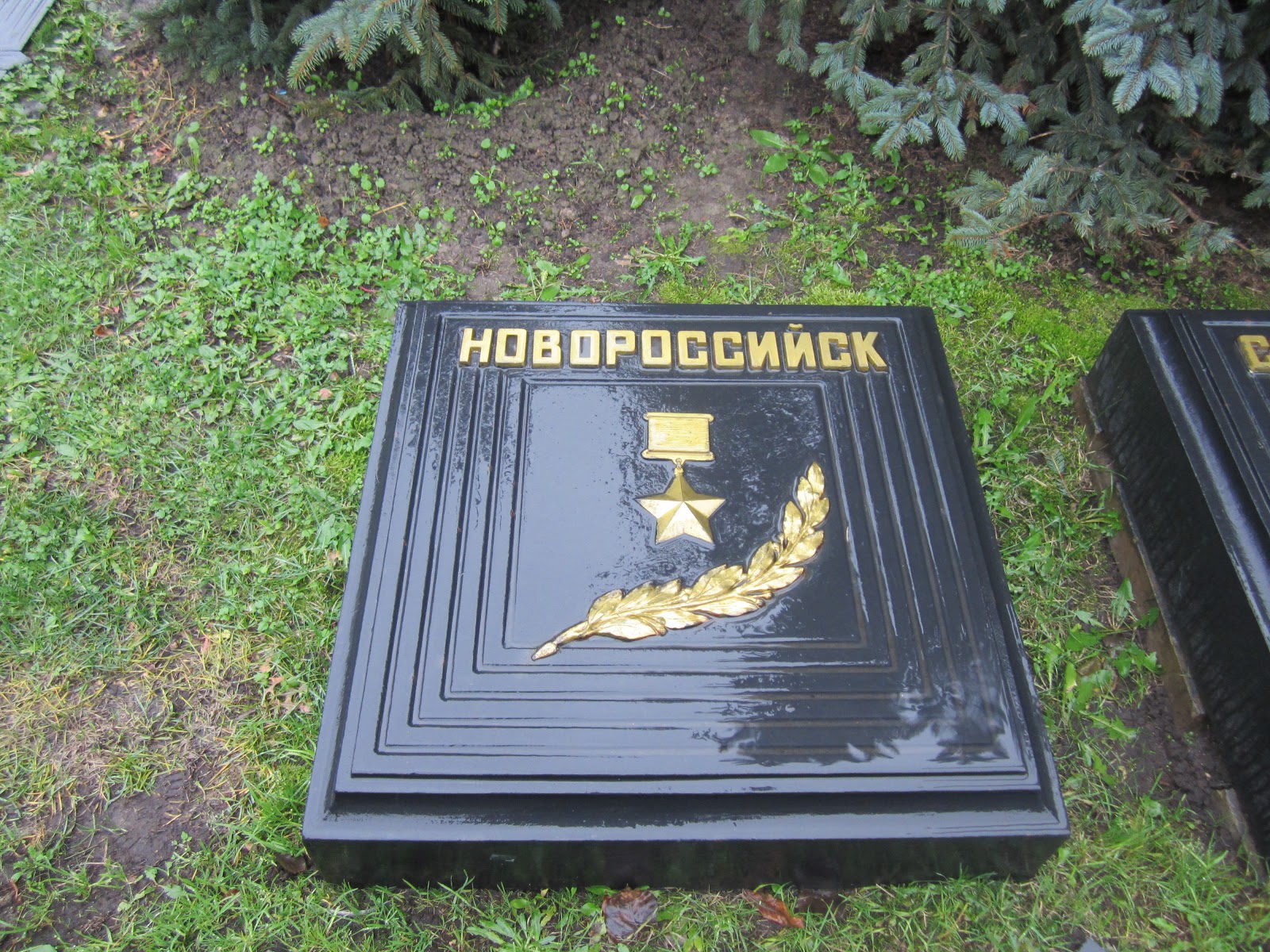
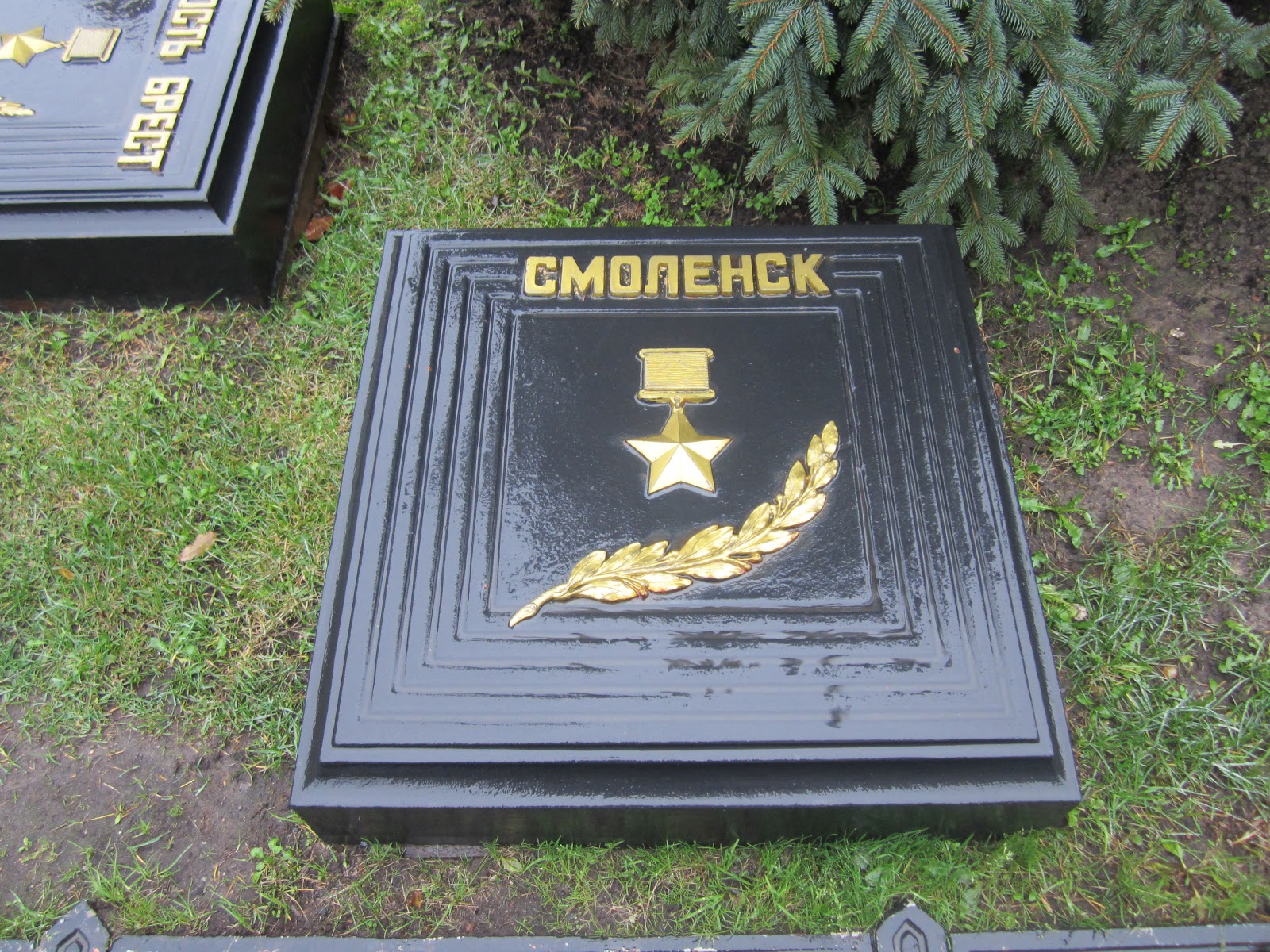
If you walk past the obelisk and down the stairs, there is a bush with plates surrounding it. On each of the plates are the names of the cities that were affected by the siege of Leningrad:


(For those who don't speak Russian, those names are: Novosibirsk, Kerch', Sevastapol, Smolensk, Tula, Krepost Brest, Murmansk, Kiev, Moscow, Minsk, Odessa, and Volgoryad.)

The exits to and from the Memorial Hall are on either side of this bush; however, looking forward from here, you can see the main part of the monument.


In the center is a statue of the victims, and heroes, of the Siege of Leningrad; and all around, torches light up the memorial writing dedicated to the fallen. Also, interestingly enough, the symbols on the wall are all different orders, and honors; only one of them, the Order of Lenin, is repeated twice.


(Kudos to whoever knows what these orders actually mean.)

When you walk into this area, you walk into a break from the circular overhang; and on either side of the overhang are the words, "900 days" and "900 nights".


The Memorial Hall

The tone is just as somber the moment you walk in: a wall dedicated to the fallen of the Siege of Leningrad, and red mood-lighting leading the way into the actual museum.


The museum itself is absolutely gorgeous-- not huge, by any stretch of the imagination, but still very effective in setting the mood. And here's where I get to actually reviewing.


The lighting makes every thing more intense; however, as all of the exhibits are covered in glass, this makes taking photos somewhat difficult. (It should be obvious from the number of photos that photography is allowed here; still, I found that a good policy is always asking if it's allowed, rather than finding out the hard way.) This museum also utilizes multimedia in the form of music (very appropriately somber), films (the films are what got to me the most-- footage from the siege, including people carrying sleds filled with dead bodies from the streets), and pictures, as well as a giant light-up map of the siege and cities affected by it. 

Rather than try to talk about the actual exhibition, I decided it would be best to present everything as I saw it; however, I can explain the way that the museum is organized. The part that you see when first walking in-- the one shown here-- is when the war first broke out, followed by the other side, which is the eventual victory. All along the way, there are different artifacts to demonstrate the varying aspects of the war effort-- the soldiers, the navy, anti-aircraft efforts-- along with a plaque, both in English and Russian. And different forms of wartime media cover the walls, which, in certain cases, could be equally disturbing.

For example:

Caricatures of Hitler


          Goebbels (also spelled Gebbels; Hitler's Head of Propaganda)


Goering (Head of the Luftwafa, and at one point, Hitler's second-in-command)


Himmler (Chief of Police and head of the SS)


Antonescu (Authoritarian dictator of Romania during WWII times)


Laval (Second-in-command of the Vichy Government in France)


And Mannerheim (Commander-in-Chief of Finland's Defense Forces)


Overall, this museum was incredibly effective at delivering the desired narrative, and was very informative. I highly recommend it. I will be including the actual narrative as laid out by the museum in another post; the exhibits speak for themselves.