Showing posts with label review. Show all posts

Wednesday, December 12, 2012

Churches in Review: Epic Photo Time

I've had a dilemma: I've seen many a church while I've been out here, but I haven't gone in; and thus, I can't really comment on their interior, or give a great review. So, instead, I'm saying that these churches are all really awesome to look at, and are oftentimes really close to other things that you would want to see.

And I'm dumping them all in an album, so you can see how shiny and pretty they are, and decide that you want to see them. Or not. No counting for tastes.

Epic Church Time

Museum Review: Academy of Artists

Okay, so I'll be the first to admit that when I first got to this museum, I didn't have my hopes very high. I mean, sure, it COULD be interesting, but nine chances out of ten, I was going to be bored silly; I had no idea what kind of art they would show, how the inside of the museum would look, etc.

Well, I am SO happy to say that my expectations were proven to be wrong. The Museum of Artists, after a rocky start, turned out to be AMAZING. The first part of the museum was Russian Neorealism-- which, I'll admit, could be hit or miss-- but they had this AWESOME section on Soviet politics, of which I took a bunch photos. Then they had maps, drawings of buildings... I was rather pleased.

Then there's the actual building itself. The Academy of Artists is located in an actual palace-- that's the reason why the building normally stands out on most tourist maps. One of the rooms in the Neorealist art section is actually dedicated to an artist named Titan; his paintings cover massive panels on the walls, and are rather awesome to look at.

Statues, older artwork, newer artwork... This museum made me rather happy. Worth noting is the modern Russian artwork; you have no idea how hard I laughed (internally) when I saw a painting of a hockey game sitting in a museum. Ah, Russia....

Academy of Artists

Tuesday, December 11, 2012

Museum Review: The Museum of the Secret Police and the Popov Museum of Communications

Now, looking at the title of this post, one might ask, why on earth would two such drastically different museums be clumped together in one post?

The answer, of course, is that Princess and I visited these museums the same day. And lord almighty, was THAT a paranoia inducing experience.

The first museum we saw was the Museum of the Secret Police. I have no pictures, nor would they be strictly-speaking necessary; the museum set-up itself wasn't very impressive. What made this museum unique, however, is that they give a very realistic impersonation of how it would feel to be hunted down by the Russian secret police.

And no, they didn't do this on purpose.

The security in this museum was absolutely ridiculous-- it overshadowed the entire experience. Putting it mildly, the tour guide wasn't there to explain things to us-- she was there to make sure we didn't accidentally trip any of the security measures. You would see something fascinating-- a hand grenade used by secret agents; the old-fashioned uniform; a cool, high-tech watch like in the James Bond films, except something that was actually used by agents-- and if you were to lean forward, even, to get a better look, the tour guide would rush over and urge, "Back away! You almost tripped the sensors!" One time, I was four inches away from the display case, but I was wearing my jacket open and the button brushed against the case; the lady acted as if the world was about to end.

The best moment of all in the museum was when Princess and I entered the room housing a replica of the Secret Police's quarters during their foundation; before we even walked in, the tour guide quickly jumped over and explained, "Be careful-- if you lean against any part of this wall, you'll trip the sensors." Princess and I seriously wondered if leaning against the wall would cause the entire building to explode in self-defense; and especially after we heard the tour guide talking about acts done by the Secret Police in response to their American counterparts, we decided it would probably be best if we fled. Which we promptly did.

Take that, and compare it to the Popov Museum of Communications: open, kid-friendly, interactive. Sure, we got glared at and even yelled at for having forgotten to take off our coats; but the exhibits were really cool, they had a great layout, great examples, and the entire experience was fun.

So, for the first time ever, I do NOT recommend a museum (the Museum of the Secret Police), though I do highly recommend the Museum of Communications. I'm a person who normally doesn't have the attention span for museums such as this; so if I found it interesting, if you're a person actually INTERESTED in communications, it should be like paradise.

Saturday, December 1, 2012

Museum Review: Three Temporary Exhibitions at the Peter and Paul Fortress

This review is going to rely a bit on "you're going to just have to believe me", as opposed to my normal method of "LOOK AT ALL THE SHINY STUFF".

The first time that Princess and I went to the Peter and Paul Fortress, we ended up hitting up three temporary exhibits. The main difference between these and the normal ones?

1) The magical student ID card only gets you a discount;
2) The exhibitions can be slightly shorter, but tend to delve further into a topic; and
3) The topic is either a) far more gruesome, or b) far more fanciful than any reasonable adult would want to go every time they went to this museum for free. 

Oh, and obviously,

4) These exhibitions are temporary.

Now, I did mention that these exhibits can be either far too gruesome, or far too fanciful. And the reason I describe it thusly is that two of the exhibitions that Princess and I saw were so gruesome, we couldn't bring ourselves to take pictures, and the other was so fanciful that I took pictures of EVERYTHING even though there was only a room and a half.

The first two: A history of torture in St. Petersburg (definitely a light, cheery subject), and Peter the Great's museum of genetic mutations (literally rooms of babies in jars).

The last?

HIDDEN DRAGONS.

Now, I don't know about you, but I love me some animatronic dragons. Add dragon-themed interactive games to the mix, and I'm as happy as a five year old with its parents' credit card in a candy story.

So, to give you a sense of how awesome the dragon-themed exhibition was (because, again, I do not have pictures of the other two, nor do I feel inclined to describe the different methods of torture in Russia/dead babies and the effects of deadly diseases), here is a link to the photo album. Yay shiny animatronic dragons!

Dragon Exhibition 
Now, the important thing: Would I recommend going to any of these exhibits?

Yes. Definitely. They were quite informative, and generally well-put together, though some exhibits within the exhibition were obviously meant or Russian audiences only.

Would I recommend going to two depressing ones in the same day?

Only if there are shiny dragons at the end of the tunnel.

Friday, November 30, 2012

Museum Review: Commandant's House in Peter and Paul Fortress

I'm so happy today is November 24!

Because today is November 24, it makes perfect sense for me to finish off my museum exhibition reviews for the Peter and Paul Fortress-- because I only went three days ago. Yay!

So when I was at the Peter and Paul Fortress-- which was totally yesterday-- the last exhibition that Princess and I saw was the Commandant's House. To be perfectly honest, I didn't entirely understand what the "theme" of the House was supposed to be-- I mean, it was all about the Peter and Paul Fortress, but (in pictures that are as unavailable to you as they are to me) there were other parts of the exhibit which didn't entirely relate-- like a railroad, and something having to do with a lake. My best guess is that it's a "behind-the-scenes" look at the building of the Fortress... just a guess, though.

However, the general makeup of this exhibit is awesome-- for example, the entry room has a projector with a screen, and the walls surrounding it are covered in maps. The floor-- which, yes, there is a picture of-- is actually taken from either the street before modern times, or the fortress in general, I cannot recall. (My memory has grown hazy for it only being this week...)

Overall, this is another exhibition that I wholeheartedly endorse. It was a bit shorter than the others-- basically 2 1/2 rooms (or 2 rooms and a lodge above one of the rooms)-- but it was still interesting to look at, and quite fun.

Commandant's House

Friday, November 23, 2012

Museum Review: Trubetskoy Bastion Prison in the Peter and Paul Fortress

This portion of the Peter and Paul Fortress was rather fascinating, and I'm not just saying this because I study politics: this prison was used to keep political prisoners, and on each of the cells, there was the story (and sometimes the picture) of the famous dissident kept within the cell walls. Even without the backstory, the exhibit was quite awesome; it described the different conditions within the prison, and how the treatment of the prisoners and functioning of the prison changed from era to era.

It was especially interesting to see how these prisoners lived; I never realized I was claustrophobic until I walked into a room that was specifically designed to lock people (such as myself) in. The museum showed the different security measures in place to keep prisoners from communicating, and even had a brief explanation of the prisoner knocking system.

All this was interesting; the high security cells were downright terrifying.

Political prisons such as this one only served one purpose: keeping prisoners isolated. And that's exactly what cells such as this one did. Literally, it was a dark room, with absolutely no light, and absolutely nothing inside. There was another room outside of it, meant to isolate the noise; and then, the outside world. You could scream all you wanted in that prison cell (if you were actually stuck in there) and no one would ever know.

Not only that, but the descriptions tended to be almost horrifically dispassionate. For example, one placard mentioned that the stairs used to be lined with chicken wire in order to prevent their use for suicide; and then, that was all. Just a perfunctory sentence, and no more.

And then try walking up those stairs with that neutral statement in mind.

Overall, I highly recommend this exhibit. It might make you squeamish, if you're one with an over-active imagination (like I am); however, it's still rather informative, and personally helped me increase my understanding of why being a political prisoner in any era of Russian history was such a terrible thing.

Trubetskoy Bastion Prison

Sunday, November 18, 2012

Museum Review: Yelagin Palace (and Central Park)

This palace is directly next to the Museum of Glass Art. Well, I guess the more accurate statement would be "The Museum of Glass Art is built on the grounds of the Yelagin Palace"; but who cares about accuracy, anyway?

This palace was home to the mother of one of the tsars, making me wish that I could be a tsaritsa (it's pretty much the Russian equivalent of a princess) and wake up in a house like that. Everything was beautiful, and absolutely gorgeous-- turns out people back then really knew how to decorate.

The palace isn't particularly gigantic, but the gorgeousness of the place more than makes up for it. It's nowhere near as ritzy as the Yusopov Palace, but I think it's more enchanting because I could actually picture myself LIVING in a place like that, as opposed to the Yusopov Palace or the Hermitage (where I would get hopelessly lost).

Also, this time, Princess and I got in free, but only because we are students at an institute of CULTURE. The lady even verified what institute we were at before handing us the free tickets, which was nice since free is our favorite price.

Overall, when in St. Petersburg, I would recommend a day or two to walk through the two parks-- Central Park and Park Pobediy (which, oddly enough, does not have its own post; I am quite shocked)-- not only because it's quite beautiful during the spring, summer, and fall, but because these two museums are perfect for stopping by and checking out.

Additionally, Princess and I specifically got the билет (pronounced "bee-let") so that we could see all three parts of the Yelagin Palace. For example, outside of the ticket counter, there is a mini-museum of exhibits for particular artists. (For example, when we went yesterday, we thought the first half of the exhibit-- the lower floor-- was amazing, and that the upper floor sucked. One was photos that were less artistic than just poorly done [I'm sorry, a five year old could have taken some of them-- yes, this is the one on the second floor]; the other was  a painter who only worked on materials. Her artwork was absolutely gorgeous-- I never knew paint on wool could be so beautiful.)

Anyways, both the parks and the museums receive nothing but thumbs up from me, and hopefully after seeing all these pictures, you'll agree.

Yelagin Palace

Museum Review: Museum of Glass Art

Right off the bat, I have to say that I am biased towards these sorts of things, and that anything that is super shiny will make me hysterically happy with joy.

That being said, this museum is my favorite. Ever.

Is it sad that I find a museum filled with nothing but glass better than the Hermitage? Yes, probably. But for sheer entertainment value, (or the level to which I was excited), this museum was the best that I've seen, and by far the most entertaining.

Another benefit to this museum: This museum is directly next door to the Yelagin Palace (why, as a matter of fact, yes, there is a review of that coming up in the near future; how did you know?) and in the middle of Central Park-- you know, the area in which I had a photo-taking spree of nothing but lake shots? (It's quite eerie to compare the lake shots of yester-visit to the gray, dull, rainy reality of my visit yesterday. Are there photos? Well, when are there not?)

The museum starts with an explanation of how glass art is made (all in Russian, but with a very helpful video on the side), followed by countless examples of different kinds of glass. The art can range from classical vases (with awesome etchings in them) to crazy works of art that can only be understood by finding the right angle. (There was one which I still don't know what the proper angle should have been.)

I highly, HIGHLY recommend this museum. For students, the ticket is free; and everything is so beautiful that even though the museum is small, it is worth every single moment.

The Museum of Glass Art

Thursday, November 15, 2012

Museum Review: St. Michael's Castle

What's the difference between a castle and a palace?

If St. Michael's Castle is any indicator, a castle is like a palace's little brother-- still just as ritzy, but just slightly smaller. (It's especially interesting to go into a castle directly after going through a palace; the experience was generally a cause for much soul-searching, as I was always standing there, thinking, "So, wait... How is this different, again?")

I really liked going through this castle, not only because of the fact that it was big, beautiful, and littered with shiny statues (I like shiny statues), but also due to the fact that it actually helped me somewhat solidify my understanding of Russian history. (I'm taking Russian History at the moment, and while I'm normally hopelessly lost in class, what little I DO understand is popping up in my head whenever I see things having to do with the class, especially when there's an entire hallway filled with nothing but portraits of Russian tsars and tsarinas. Quite helpful.)

You knew there was a ceiling shot coming at some point-- I am the photographer of ceilings, after all.
Keep in mind that castles are smaller than palaces to begin with-- so that, combined with the fact that half of the castle is off-limits for civilians and non-governmental employees means that there is very little space.

However, these people KNOW how to utilize that space.

From the corridor filled with pictures of tsars and tsarinas (shown above), to the corridor filled with amazing tapestries, the upstairs portion of this museum is just glorious. Wrapping my mind around the fact that the tsar lived in places like these always makes my head hurt; and adding works of art that are probably worth more than the entirety of my education (both now and projected), all the houses that my family lives in, and my entire lifetime's estimated (projected) income certainly adds to the "wow" factor.

Then there's the downstairs. (Cue my transformation from culturally informed young adult to hyperactive and overenthusiastic kid in a candy shop.)

Downstairs, they have a MASSIVE collection of statues. I'm not just talking about the main room that you walk into, where statues line all of the walls; there's even a collection of statues sitting on shelves in the middle of (what I'm imagining are temperature-, humidity-, and pressure-controlled) glass panels.

The last part of the museum was the one in which I wanted to take the most pictures. It was also the one in which I took the fewest.

When looking at the photo album, there is one massively important thing to keep in mind: the creators of all of these art pieces were at the very least 9, and at the very most 16 years old.

How is that impressive? Well, let's see:


Now, maybe this is just me, but seeing THIS and thinking of how old these kids are makes me sit back and go, "Huh. Well, now my life feels hugely unproductive." I mean, come on-- a ten year old made an entire nature scene entirely out of leaves. LEAVES. This kid, whoever they are, have a million times more dedication, patience, artistic talent, and access to leaves than I ever have, or ever will.

Overall, this museum is great-- students get in for free (oh yes!), photography is rather cheap, and everything is thought provoking, whether seeing glimpses from the lives of the tsars (through portraits and walking through the castle) or admiring the works of Russia's future artists. And with its prime location, St. Michael's castle is delightfully easy to get to-- it's on the other side of the street from the Summer Garden, near Mikhailovsky Park (hmm, wonder where that name could have come from), a ten to fifteen minute walk away from the Church of the Spilled Blood, ridiculously close to the Russian Museum... I could continue, but I think that in this case, overkill is overrated. As long as you're in the area, you would be served well to visit this Museum. I promise, you won't regret it.

St. Michael's Castle

Wednesday, November 14, 2012

Museum Review: The Museum of Music (a.k.a. the Sheremetev Palace)

WARNING: THIS REVIEW IS WRITTEN BY AN EX-MUSIC MAJOR.

My feelings were very mixed about this Museum. 

On the one hand, half of it was under construction, most of it was inaccessible, and even after paying 200 rubles for photography (6 USD), we weren't allowed to take pictures in more than half the rooms.

On the other hand, everything on the inside that WAS open was absolutely gorgeous, there was musical instruments galore (I mean, come on-- a real Stradivarius violin!), and my weapons-and-musical-instrument-magpie self got to geek out over gilded rifles, swords, and an INSANE bugle being within three glass exhibits of each other.

While I get to reminisce about all the beautiful things I saw-- the ritziest rooms, with glass vases, fine works of art, beautifully crafted pieces used in the daily life of Sheremetev (and of which photography is prohibited)-- I also look back at the photo album of this museum, and wrinkle my nose with annoyance at the realization that I have photos of less than HALF of what I saw there today.

Could photos have captured the feeling of rapture at listening to a piece written for piano and violin echo within the lavish walls of a single room of this palace? 

No. 

Could photos explain how, suddenly, so many pieces of classical music (which I had previously found unbearably dull) made sense, within the context of this style of life? 

Again, no.

But could photos have illustrated how awesome a gun embellished with mother-of-pearl carvings and a sword with a velvet-upholstered sheath look, especially when there's a bugle as twisted as Medusa's hair one case over?

... I rest my case.

Overall, this museum is a great place to visit-- you get to be within amazing proximity of some of the most amazing instruments in the world (namely that Stradivarius-- man, is that rare). However, don't spring for the photos; if more of the museum was open, and/or more of the rooms were open for photography, I would wholeheartedly endorse the purchase; however, it would be better to just hold off, and instead buy photos for the Hermitage, or any museum other than this one.

Museum of Music (a.k.a. Sheremetev Palace)

Tuesday, November 13, 2012

Museum Review: The Hermitage

For those who were holding their breaths at my absence, (as if that was happening,) for the last week or so, I've been seeing and doing more than I've been posting. (A revolutionary new concept, I know; it's one I'm still working on mastering, much like how I still haven't gotten the hang of walking through doorways without banging some part of my body into the door.) And now, I have a review of one of the most famous sights in the entirety of St. Petersburg: the Hermitage.

The Hermitage actually took two days for Princess and I to explore, considering that the first day was split between the Hermitage, the Synagogue, and various other sundry tasks. This leads me to point #1: If you are going to go to the Hermitage, make sure to get there as early as you can, and be prepared to devote the entire day to wandering up and down its fantastic halls.

Point #2: The Hermitage is one of those awesome places where student IDs will get you in free, no matter what your nationality. (There are actually museums where this is not the case, such as the Yusopov palace; it's a shame, but really, it's only fair to expect the magical student ID to get you so far.)

That being said, be prepared for an information discrepancy as a foreigner, as even one glance at the signs at the Hermitage will show that there is a bias towards giving Russians more background information on pieces of art.

Just sayin'.
*As a hilarious note, be especially wary of this difference when looking at prices: oftentimes, what ends up happening is that most price discounts (such as discounts to the elderly, or to students) are written on the Russian sign, but not on the English one. (I have a picture of this from St. Isaac's Cathedral, but because the file is corrupted, I cannot post it.)

With such an information gap, it is thus really helpful to have Russian friends to come along with you. They can point out all the works of art that are famous in Russia, be horrified when you have no idea what something is, and give you either same amount of information (or more) on different pieces throughout the museum, including cultural tips on Russia. Plus, it's a great way to bond with friends in Russia, and a great way to unintentionally exercise. (I know I mentioned it before, but man, can the Hermitage be brutal.)

The Hermitage, for those who are curious, consists of three floors, which contain:


(Like I said, this thing is HUGE.)

Additionally, as you can see in the floor plans, there is TONS to see, making it so that even if there are entire exhibits that bore you to tears (such as still-lifes and portraits, for me, or hunting scenes and daily life paintings for Princess), you can skip past them, and still have enough pictures to last you a lifetime.

Which is why the photo album for this museum is so danged huge.

The Hermitage: Photos from Days One and Two
Just warning you, guys, this is NOT an album you want to sit down and look at in one sitting-- there are SO many photos of SO many different things that skimming for things that look shiny might be your best bet. (And if you think the photos are a lot to get through, try walking through the entire museum.)

The craziest thing about the Hermitage, however, is thinking that people actually LIVED here. Like, I would get lost at least seven times a day if I lived here; heck, I get lost walking home from Judo, much less living in a palace. But that's part of the charm of the Hermitage: every room is an experience, and even if we as measly tourists get lost, the art, and paintings, and statues, and ceilings, and floors, and chandeliers, and furniture all know exactly where they are. And as long as they stay still, that makes wandering a beautiful and exciting adventure.

Saturday, November 10, 2012

Church Review: Church of the Spilled Blood

This church has been taunting Princess and I for at least a week, now.

Standing down the street from the famous Dom Knigi and Kazan Cathedral, this church is absolutely gorgeous on the outside-- every inch is covered in color, with mosaics and spires and icons... Absolutely fantastic. And the history is even richer than the church; for this church was built on the spot that Alexander II was assassinated, and is actually dedicated in his honor.


Knowing that, Princess and I were convinced that we had to go inside... Yet day after day, things kept coming up, and we didn't end up seeing it.

Until today.

Now, for those who are photo-happy, like I am, this church is a nightmare. There is SO MUCH to take pictures of, and so many different aspects to photograph, that the entire experience becomes a thing of torture. A great arm-workout, though; and painful on the neck.

In other words, I whole-heartedly recommend that you see this cathedral.

Once again, admission is free for students (I've even started creating a "student ID" song that I'm singing when we buy tickets), and even if it weren't, this church is so beautiful that every ruble spent is worth it. The inside is nothing but mosaics-- the walls, the ceiling... And you can even see the spot where Alexander II was shot. It's the most epic manifestation of a history class you could hope to see.


So, while google reviews makes me feel like my reviews are totally pathetic (Google rates this as "exquisite; flawless; perfection"; I rate it as "epic, awesome, shiny"), I do agree with Google's sentiment that this church is one you DEFINITELY have to see.

Church of the Spilled Blood

Tuesday, November 6, 2012

Church Review: Kazan Cathedral

So, some might (or might not) remember the photos I took of a certain building with a very impressive dome and columns, which I had no idea what it was called.

(To jog your memory, I'm talking about this:

For those who are curious, this photo is literally called "mysterious building panorama".
See? Impressive dome and columns.)

As it turns out, this is none other than Kazan Cathedral, which houses the oldest and most sacred relic in Saint Petersburg. The building on the outside is quite pretty; the inside, however, is absolutely stunning.

Here is my disclaimer: Any and all pictures I use of the cathedral from this point are not photos that I have taken-- unfortunately, like the Museum of the History of Religion (and the metro), the church doesn't allow photography. However, other people have taken pictures of what I cannot; and thus, everything that I saw can be shown (instead of having me pathetically try to describe things that are just too beautiful and intricate for words).

So, this is a general shot of the inside of the cathedral:


At the very front left-hand side (you can follow the line of people), there is a copy of the famous icon that I mentioned before; and the icon itself is in the center, directly under the chandelier. Everything is painted gold, and there are icons scattered EVERYWHERE.

However, I should really clarify and say that this is what it looks like when illuminated; when I went there, even with it being the middle of the day, the cathedral actually looked more like this:


Additionally, there is always (it seems) a huge line of people waiting to kiss the icon. I'd say it was unique, except that it was possible to pull up a photo of a line within one scroll of a google search:


Overall, however, I would highly recommend visiting the Kazan Cathedral: it is open and free for everyone (not just us who have magical student IDs), and while you can't take actual photos inside, it is still worth seeing for yourself. (I've noticed that there are certain things that you really have to see to believe.)

Whether or not you kiss the icon is entirely up to you; but even if it's to wander in for five minutes, mourn that you can't take pictures, and then scour Google for images to save (not like I just did that or anything), it's an extremely satisfying and beautiful site.

(All outside and inside photos of this cathedral can be found here.)

Monday, November 5, 2012

Church Review: St. Isaac's Cathedral

Well, this review has been a week in waiting.

I absolutely love this cathedral-- the architecture on the inside is absolutely epic, and I know I looked ridiculous running around taking nothing but ceiling shots. Also, for students with valid student ID, this entire museum is free. (God, I love Russia.)

The museum can be quite crowded, and the different paintings hard to see; however, it is entirely worth it, because of how beautiful the interior is.


Also, the lightning is absolutely superb-- everything shows up BEAUTIFULLY in photography. However, a word for the wise: I actually recommend that you take as many pictures as possible, because in certain areas, you can see more of the cathedral by taking a picture than with the naked eye.

(Here, for example.)
All of my pictures for this cathedral can be found in the album "St. Isaac's Cathedral" (I know, such an original name.)

Sunday, November 4, 2012

Museum Review: Yusopov Palace

Cost: 380 Rubles for Foreign Students (though the price is literally half if you're Russian)
Rating: Five out of Five

This palace was absolutely stunning. At first, it seemed like the cost was a bit steep (I mean, ANYTHING is expensive compared to free; and normally, our student IDs would get us free access to pretty much everything and anything we go to). Also, due to timing issues, we ended up missing a fantastic exhibit, and are going to have to return at some later date in order to see it. However, not only because of how beautiful it is, but because of the history of the place, I would highly, highly recommend visiting this palace.

Why?

Because this is the place that they tried to kill Grigory Rasputin.

Now, you might not be a Russia-nerd like me (or have had as much of a childhood obsession with the movie Anastasia as I did), but this museum has an exhibit open exclusively discussing the death of Grigory Rasputin. (Ergo why Princess and I are returning sometime in the near future.)

Prince Yusopov belonged to one of the richest families in all of Russia, a family richer than even the tsar's. (They owned numerous castles in both St. Petersburg and Moscow, including this one on the bank of the Naberezhnaya River.) Yusopov married the niece of the tsar at the time, Tsar Nicholas II. However, the thing that made him the most famous is the fact that he was the one who decided that Rasputin must be killed.

The version of this story that I heard this morning varied somewhat from the version that I heard when I was taking European History in high school, but the main details remained the same: Prince Yusopov invited Rasputin to have  tea at his palace. The tea (or wine, depending on your version) and cakes that were served, however, were all laced with arsenic; and yet, after consuming massive amounts of the stuff, Rasputin seemed to be totally unfazed. Out of desperation, Yusopov and his accomplices stabbed Rasputin multiple times; and yet, the cleric continued to live on, limping out of the courtyard. (In the version I heard in high school, Rasputin even opened his eyes when they were trying to make sure he was dead, wagged one finger, declared, "You naughty, naughty boy", and began strangling Prince Yusopov. Entertaining, but I don't know if it's true.) Finally, they shot him, grabbed him up, took him out to a bridge (yeah, that bridge that I pointed out in Bruce and the Bruces-- man, gotta love history), and tossed him into the water, only for it to be discovered later that only the Russian winter could kill him. (Rasputin's body was found clawing its way out of the river, until he got frozen in.)

Obviously, I am highly enthused about this museum exhibit. However, seeing as I did NOT get to see this exhibit, I still highly recommend the rest of the museum, anyway.

*Note: All of the pictures from this museum can be seen in the album "Sennaya Ploschad Day".

Every single room is based on a different theme; so, this is how you can have rooms as different as these:

What I'm calling "The Blue Room"

Concert Hall
Home Theater


What I'm calling "the Drawing Room"

The Moorish Room
I took pictures of practically everything, just because there were so many beautiful things-- statues, vases, paintings, chandeliers. It was utterly fantastic. So, even if it cost a bit more-- hey, you only live once, right? (Or slightly longer than once, if you're Rasputin.)

Church Review: St. Nicholas Naval Cathedral and Church of Ss Isidor and Nicholas

Both of these churches are absolutely fantastic to look at from the outside, though I have no idea how the interior is as we did not enter either of them. (It seemed like a bad thing to do, entering a church on a day of worship in order to gawk like a tourist.)

These two houses of worship are being reviewed together because they are literally down the street from each other. The first, and most famous, is the St. Nicholas Naval Cathedral, and it is the easiest to spot.


The next church, the Church of Saints Isidore and Nicholas, was one of the most wonderful churches to see, simply because it contained a color that I have not seen on any other church: green.


The website on which I read about this church said that the inside was not much to look at; however, even if it had been, it wouldn't have made a difference, simply because the majority of the churches (and cathedrals) that Princess and I have visited were in use, meaning that acting like my touristy self would have been entirely unacceptable and inappropriate. And how can I write about these gorgeous churches if I get myself blacklisted from religious establishments?

So, I can highly recommend these churches-- they're surprisingly close to St. Isaac's Cathedral and Admiralteiskaya metro station, plus when walking from Sennaya Ploschad, one walks directly past the Central Train Museum (review coming up in just a bit) and Yusopov Park, which is quite pretty. Even from just a "stand outside and snap photos", these churches (or cathedrals-- whatever) are entirely worth the time and walk.

Saturday, November 3, 2012

Church Review: Church of the Birth of Saint John the Baptist (Chesme Church)

Metro: Moskovskaya
Rating: Still pending

This church, while incredibly beautiful on the outside, was unfortunately busy when Princess and I visited today. What I saw of the inside was absolutely magnificent; however, as  I am not tall enough, nor creepy enough, to take pictures of the interior of a building through a window, I only have pictures of the outside. However, I can say that the outside of this church lives up to its reputation; it's absolutely gorgeous, and very interesting to look at.


This church was apparently built on some of the oldest grounds in St. Petersburg; and behind it is one of the oldest cemetaries in St. Petersburg as well.


Even if it's to just look at the outside, I would recommend stopping by this church if you're already visiting the Monument to the Heroic Defenders of Leningrad, or the House of the Soviets (I only walked by, but it's rather impressive to look at). At the very least, it's another thing you can add to your list of "interesting cultural outings" while in Russia; and if there aren't any services going on (we're pretty sure we went there the one day there was a baptism), you can go inside and see for yourself how beautiful it looks.

Museum Review: Monument to the Heroic Defenders of Leningrad

Cost: Free to students with student ID
Cultural Experience: 5 out of 5

I found this monument and museum to be deeply affecting. From start to finish, you can see the Soviet narrative of what happened during the siege of Leningrad-- and let me say, it's a starkly depressing but inspiring narrative.

Note, this is not how I plan on executing most museum reviews; normally, I hate sounding like a dry professor in the middle of a dull history lesson. But due to the subject, and the way that this museum is structured, there's no room for humor; and rather than simply say what it is, I think with this museum, it's better if I show, rather than tell.

Structure of the Monument

Entering from the front, there are statues of "fallen heroes" on either side of you, and a statue of two men before you in front of an obelisk. This is the Monument to the Heroic Defenders of Leningrad.


This is roughly how it looks; all the pictures shown in this post can be seen in the album "Moskovskaya."


Note the years written on the obelisk. This is how long Leningrad was blockaded by the Germans: 900 days, and 900 nights.

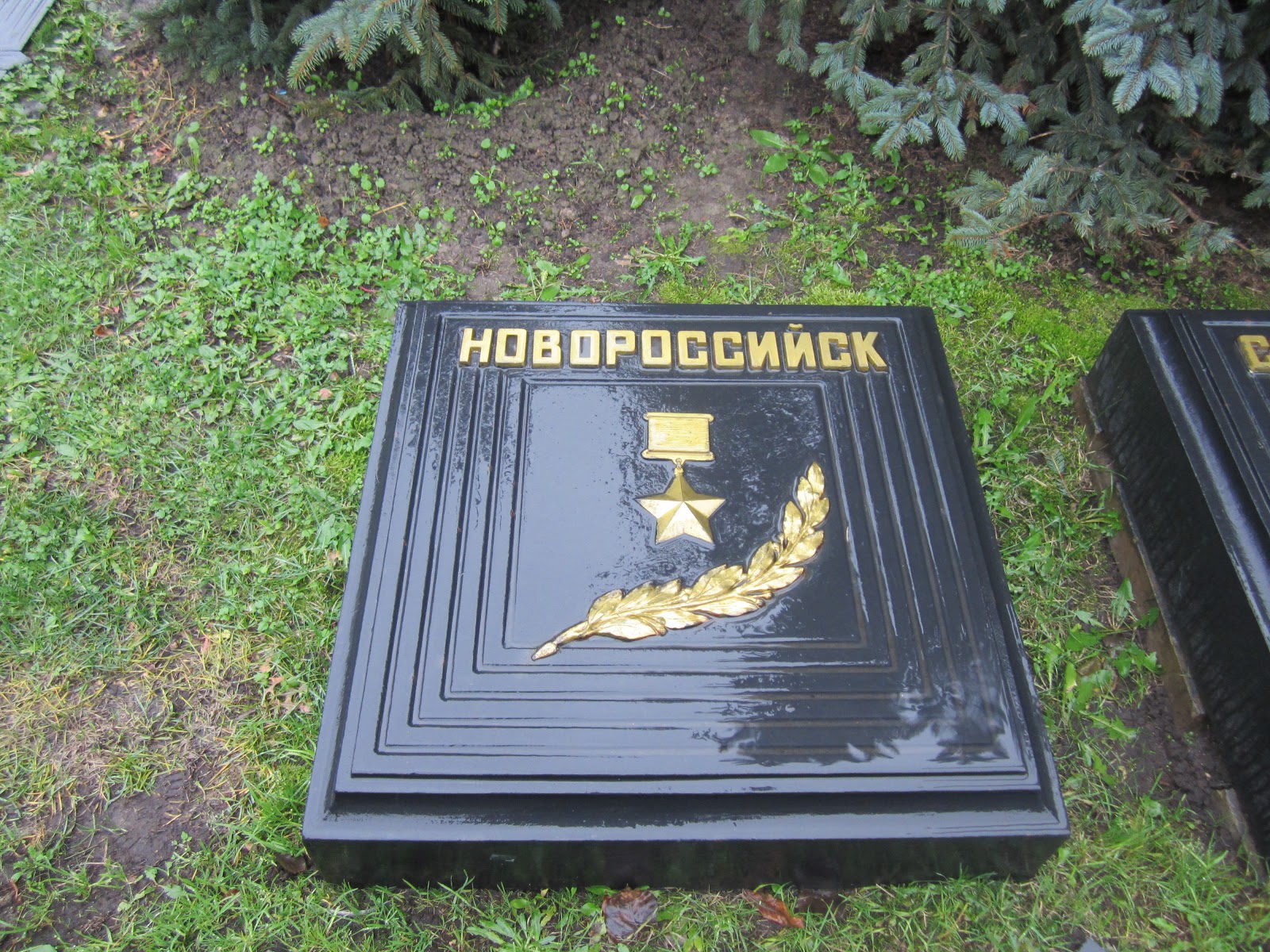
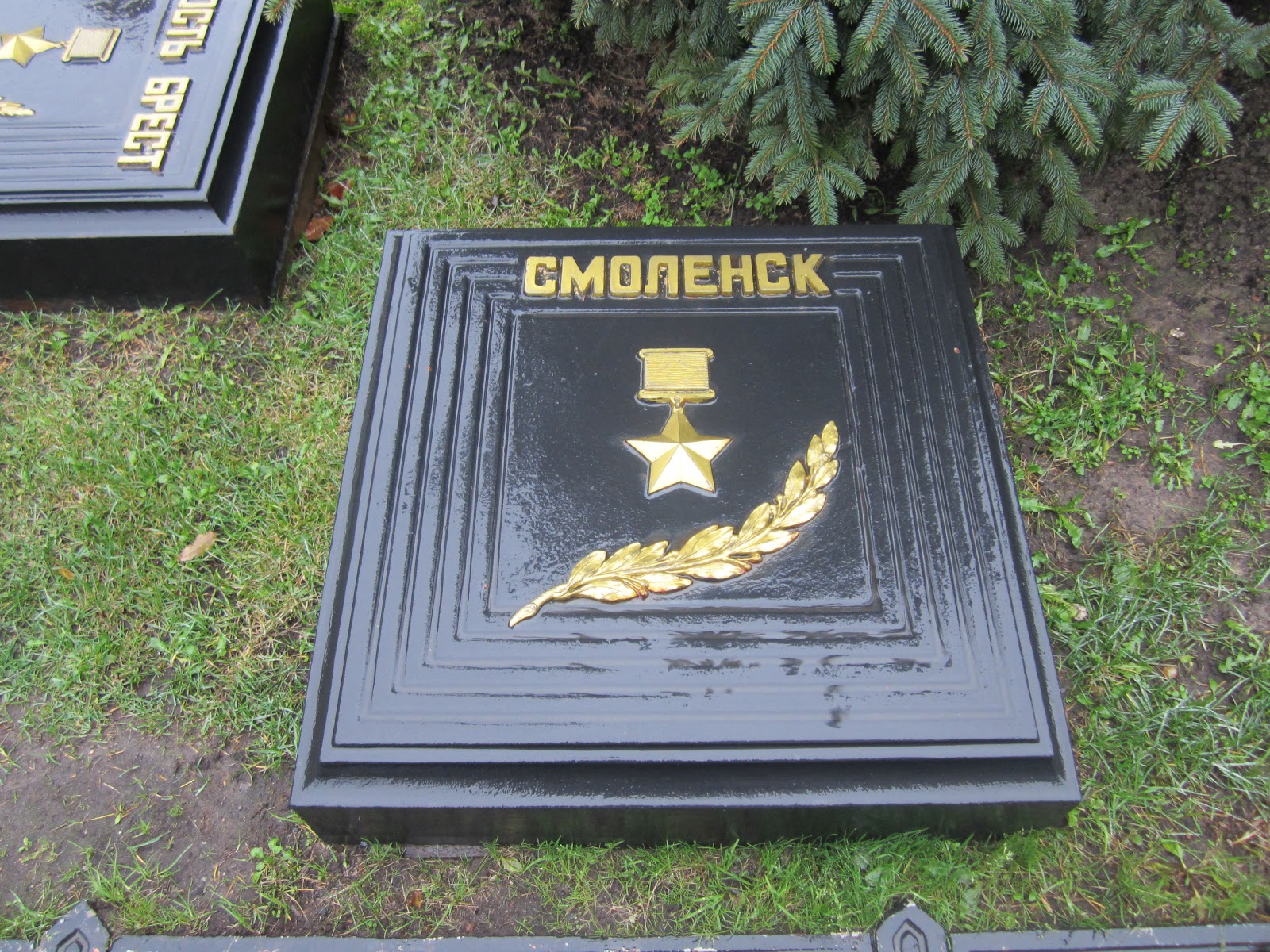
If you walk past the obelisk and down the stairs, there is a bush with plates surrounding it. On each of the plates are the names of the cities that were affected by the siege of Leningrad:


(For those who don't speak Russian, those names are: Novosibirsk, Kerch', Sevastapol, Smolensk, Tula, Krepost Brest, Murmansk, Kiev, Moscow, Minsk, Odessa, and Volgoryad.)

The exits to and from the Memorial Hall are on either side of this bush; however, looking forward from here, you can see the main part of the monument.


In the center is a statue of the victims, and heroes, of the Siege of Leningrad; and all around, torches light up the memorial writing dedicated to the fallen. Also, interestingly enough, the symbols on the wall are all different orders, and honors; only one of them, the Order of Lenin, is repeated twice.


(Kudos to whoever knows what these orders actually mean.)

When you walk into this area, you walk into a break from the circular overhang; and on either side of the overhang are the words, "900 days" and "900 nights".


The Memorial Hall

The tone is just as somber the moment you walk in: a wall dedicated to the fallen of the Siege of Leningrad, and red mood-lighting leading the way into the actual museum.


The museum itself is absolutely gorgeous-- not huge, by any stretch of the imagination, but still very effective in setting the mood. And here's where I get to actually reviewing.


The lighting makes every thing more intense; however, as all of the exhibits are covered in glass, this makes taking photos somewhat difficult. (It should be obvious from the number of photos that photography is allowed here; still, I found that a good policy is always asking if it's allowed, rather than finding out the hard way.) This museum also utilizes multimedia in the form of music (very appropriately somber), films (the films are what got to me the most-- footage from the siege, including people carrying sleds filled with dead bodies from the streets), and pictures, as well as a giant light-up map of the siege and cities affected by it. 

Rather than try to talk about the actual exhibition, I decided it would be best to present everything as I saw it; however, I can explain the way that the museum is organized. The part that you see when first walking in-- the one shown here-- is when the war first broke out, followed by the other side, which is the eventual victory. All along the way, there are different artifacts to demonstrate the varying aspects of the war effort-- the soldiers, the navy, anti-aircraft efforts-- along with a plaque, both in English and Russian. And different forms of wartime media cover the walls, which, in certain cases, could be equally disturbing.

For example:

Caricatures of Hitler


          Goebbels (also spelled Gebbels; Hitler's Head of Propaganda)


Goering (Head of the Luftwafa, and at one point, Hitler's second-in-command)


Himmler (Chief of Police and head of the SS)


Antonescu (Authoritarian dictator of Romania during WWII times)


Laval (Second-in-command of the Vichy Government in France)


And Mannerheim (Commander-in-Chief of Finland's Defense Forces)


Overall, this museum was incredibly effective at delivering the desired narrative, and was very informative. I highly recommend it. I will be including the actual narrative as laid out by the museum in another post; the exhibits speak for themselves.